
The Buzz-Free System™
Five stabilizers protect your clarity. Rhythm keeps you building.
Most founders don't have an operating system for navigating pressure, uncertainty, and distraction. The Buzz-Free System™ is a self-correcting operating system that helps founders identify the source of the noise, restore clarity, and continue building when things become unstable.
The Buzz-Free System™ is built around five stabilizers: Pace, Energy, Money, Focus, and Environment.
Together they protect clarity, activate rhythm, and support consistent movement for building your business.
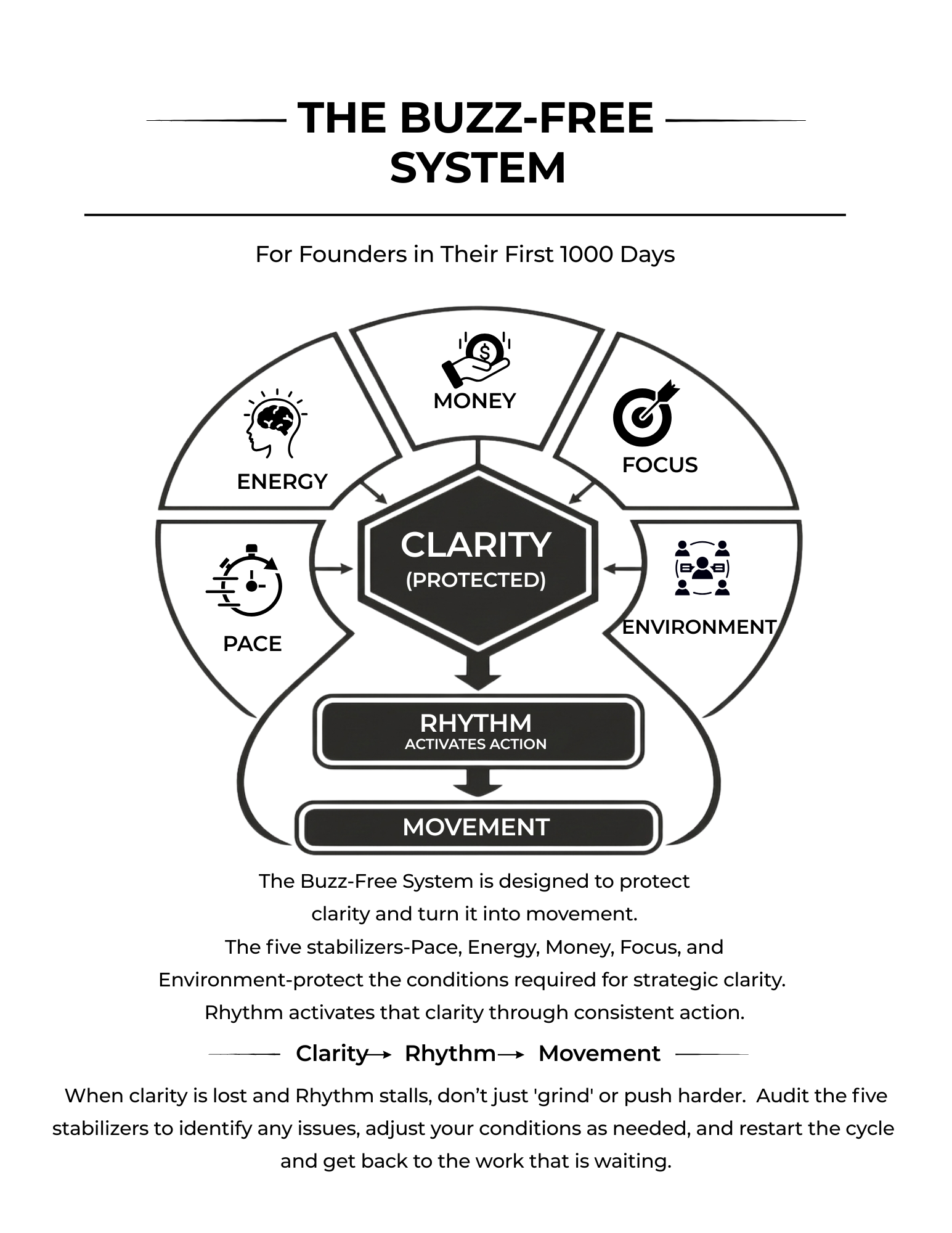
How the system flows
Each stage unlocks the next. When the pillars are steady, everything downstream takes care of itself.
01 · Stabilize the Inside
Pace, Energy, Money, and Focus are addressed in order. Each stabilizer supports the next, creating a stronger foundation for decision-making and action.
02 · Environment Falls Into Place
Most frameworks start here. We end here.
Once the environment is stable it becomes easier to shape. Whether working in an office or remote, the schedule, tools, and workflow stop being the problem.
03 · Rhythm Activates
With all five pillars steady, rhythm switches on. Building becomes consistent. Focus lasts longer. Uninterrupted flow becomes the default rather than the exception.
04 · Assess and Return
No founder stays perfectly balanced.
When something slips, identify the pillar that needs to be addressed and handle it, then return to what you were doing. The system is designed to self-correct so movement can resume quickly.
Find the buzz in your work
These six categories affect every part of your day as a founder. Each pillar is an assessment tool — a lens for spotting where noise is creeping in and what it's costing you.
Pace
Pace is the load you put on your day and the speed you move through it.
When pace is unsteady, you're answering a hundred messages, jumping between tasks, and reaching the end of the day with the important work untouched.
The solution isn't working less. It's deciding which decisions require immediate action and which improve when given time.
Before saying yes to the next opportunity, check your calendar first. If it takes time you need to recover, it's not an add-on — it's a cost.
Energy
Energy is your cognitive capacity, enhancing your brain's ability to think clearly, weigh options, and make sound decisions.
When energy is depleted, you stop looking for the right solution and start looking for the fastest one.
The warning signs appear before you notice them: - Re-reading the same message twice - Snapping at people over small things - Avoiding decisions you would normally make in 30 seconds
The fix is protecting your strongest hours for your highest-stakes work. Not whatever happens to be left at the end of the day.
Money
Money determines how long you get to keep building.
When the numbers are unclear, urgency runs the business instead of strategy. You say 'yes' to work that doesn't fit, delay what would help, and make spending decisions based on fear instead of data.
The fix is two reports: 1) Your P&L (Profit & Loss Statement): Are we making or losing money? 2) Your Cash Flow Report: How long can we operate at the rate we are going?
Consistently update your data entry in the accounting software so you can review your numbers when necessary. Review P&L after data entry to track expenses and income. Review Cash Flow weekly so you are aware of your numbers before any major expenses are made.
Clarity changes what you're willing to say 'no' to.
Focus
Focus is your ability to stay with one thing long enough to finish it.
When it breaks down, you feel busy, but nothing meaningful gets completed. Work stays open, new ideas start before old ones close, and important projects get pushed aside by things that feel urgent, but aren't.
The solution isn't more discipline.
It's completion.
When everything feels overwhelming, choose the smallest task that moves the business forward and finish it. Not the most important thing. Not the perfect thing. The thing you can actually finish without too much friction.
One completed task creates more clarity than a full day of reorganizing your list.
Environment
Most systems prioritize the environment. We put it last because a steady environment is built from the inside out.
Once pace, energy, money, and focus are steady, environment becomes secondary.
Office or remote stops being the issue.
But your space still matters. It either supports your work or competes with it.
If your environment is noisy, change it. If your inbox is chaos, treat it like an operations problem and learn how to simplify it.
Most of your business lives in your laptop, which means you are not as stuck as you think.
Small friction adds up. If you spend 10 minutes looking for something every morning, your environment is costing you clarity.
Rhythm
Rhythm isn't a pillar you tend to - it's what activates once the other five are steady. When pace is intentional, energy is protected, money is clear, focus is directed, and your environment supports the work, rhythm switches on. The day moves. Decisions get made. Work gets finished.
You'll know rhythm is working when you stop reacting to everything and start building through it. The noise is still there, it just stops running your day.
When rhythm breaks, don't assume the whole system is broken. One pillar slipped. Go back through them in order: Is my pace still intentional, or am I reacting to everyone else's urgency? Is my energy protected or have I been running on empty? Are my numbers clear, or am I avoiding them? Is my focus directed or am I busy without finishing anything? Does my environment support the work, or is it competing with it? The answer is usually in one of those five questions. Handle what is needed, and Rhythm picks back up.
These pillars aren't a checklist — they work together. When one slips, clarity slips. When all five are steady, rhythm activates and you stay in the build.
Self-correcting by design
A pillar slipped, not the system.
Buzz doesn't mean you broke the system — it means a pillar slipped. Go back to the five stabilizers and audit them in order: Pace, Energy, Money, Focus, Environment. Name where the noise is coming from, handle that one thing.
Some answers need time — a night's sleep, a conversation, a walk. That's normal. The work waits while you assess what needs your attention.
Once you know which pillar is wobbling, do your best to handle the issue until you realize the answer needed to restabilize that pillar. It's all in your hands. This system works with you so you have more information about your business. Not against you.
Subscribe to the newsletter
Practical clarity for founders — straight to your inbox. No spam.